What Is Data Access Governance?

Data access governance helps organizations control who can access sensitive information and what they can do with it. Learn how policies, permissions, reviews, and access management processes work together to reduce risk and improve efficiency.
On this page
As organizations distribute information across cloud platforms, SaaS applications, databases, analytics environments, and AI systems, controlling access becomes increasingly complex. Traditional permissions alone are often insufficient because organizations need to understand not only whether someone can sign in to a system, but also which data they can reach and what they can do with it.
Data access governance provides a structured way to manage these questions. It combines policies, access controls, ownership, monitoring, and recurring reviews to ensure sensitive information remains available to legitimate users without creating unnecessary exposure.
What Is Data Access Governance and How Does It Work?
Data access governance is the framework an organization uses to define, grant, monitor, review, and revoke access to data. Its purpose is to ensure that users, applications, service accounts, and other identities receive appropriate access based on business requirements and security policies.
In practice, access governance begins with understanding what data exists, where it is stored, how sensitive it is, and who owns it. This process is closely connected to sensitive data discovery, which helps organizations locate sensitive information, understand its context, and identify who can access it. Organizations can then determine which identities require access and establish rules that connect those identities with approved permissions.
For example, a financial analyst might need read access to revenue data but should not be able to modify payroll records. A data engineer may require broader access to a database for a specific project, while a contractor may receive permissions only for a defined period.
An effective data access governance model also follows the principle of least privilege. Users and workloads should receive only the permissions necessary to perform their assigned tasks rather than broad access that may never be used.
Access should not be considered permanent. Permissions need to change when employees join the organization, switch roles, complete projects, or leave. Periodic access reviews help confirm whether privileges are still justified and remove unnecessary permissions before they become a security risk.
This approach also supports zero trust security principles. Access decisions should be based on verified identity, policy, resource sensitivity, and relevant context instead of assuming that a user or device can be trusted simply because it is inside a corporate network.
Core Components of Data Access Governance
Effective data access governance combines several closely connected processes and technologies.
Access policies define who should be able to access particular information and under which conditions. Policies may consider job role, department, project membership, business purpose, and data classification. Classifying information according to its sensitivity and business value helps organizations apply stronger access restrictions to confidential or regulated data while avoiding unnecessary controls on low-risk information.
Permissions and roles translate governance policies into technical controls. Role-based access control can simplify common permission patterns, while more granular models can incorporate additional attributes or contextual conditions. A strong data governance access control strategy avoids unnecessarily broad privileges and applies least privilege wherever possible.
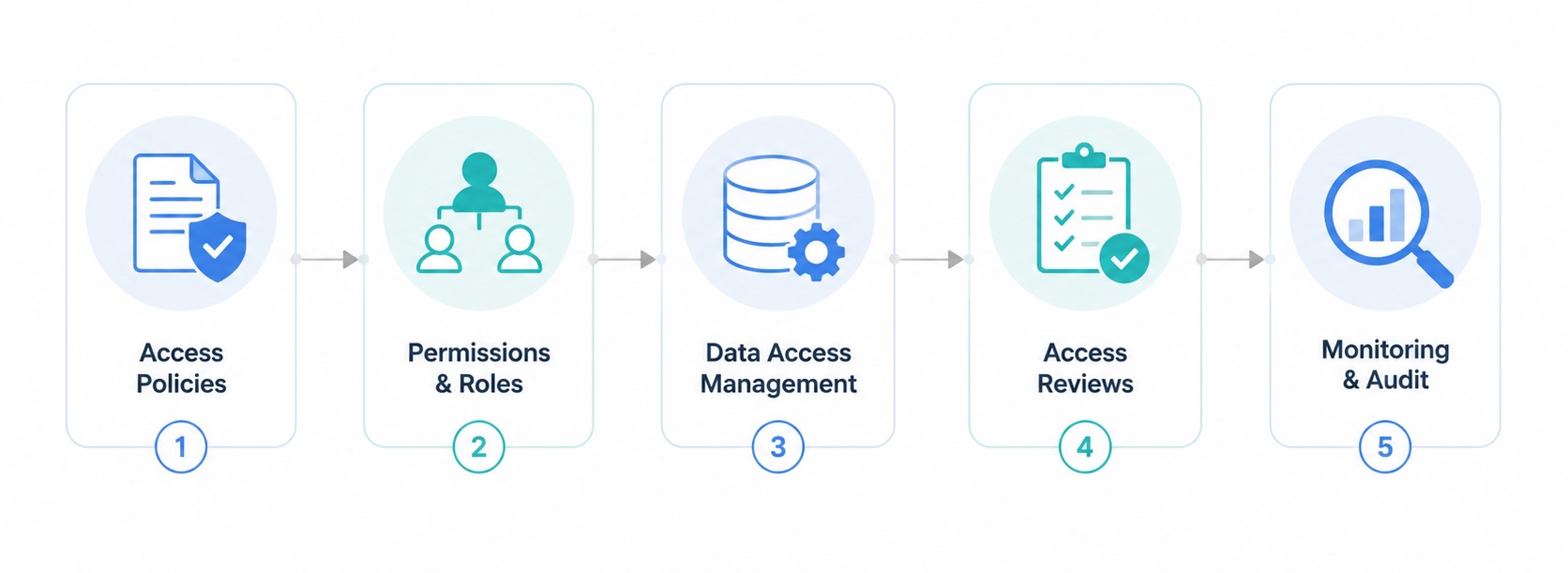
Data access management covers the operational process of granting, modifying, and removing permissions. Mature organizations connect access requests with approvals, provisioning, expiration rules, and deprovisioning. Temporary permissions can be particularly useful for contractors, short-term projects, incident response, or privileged administrative work.
Access reviews provide another essential control. Managers, data owners, security teams, or designated reviewers periodically verify whether users still require their existing privileges. Permissions that are outdated, excessive, or inconsistent with policy can then be removed or adjusted. Regular reviews are among the most important data access governance best practices because access rights tend to accumulate as responsibilities change.
Monitoring and audit records provide visibility into access decisions and activity. They help organizations investigate suspicious behavior, identify policy violations, prepare audit evidence, and understand whether actual permissions still match intended policies.
Modern data access governance solutions can also work alongside Data Security Posture Management (DSPM). DSPM adds data-centric context by discovering and classifying sensitive information and examining factors such as exposure, permissions, encryption, and access paths. Together, these capabilities can help security teams identify situations where sensitive information is accessible more broadly than intended.
Data Access Governance vs IAM and User Access Governance
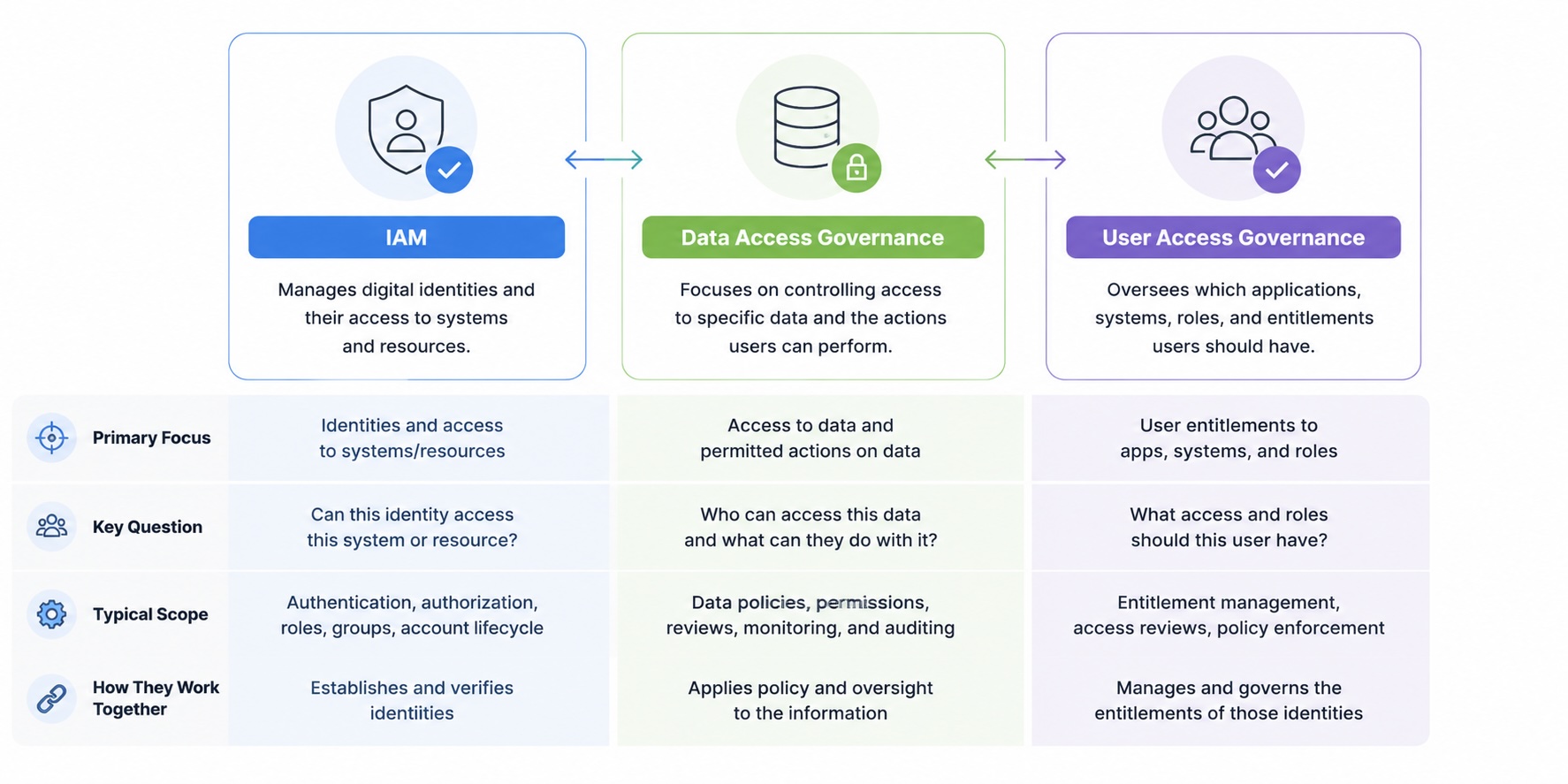
Data access governance, identity and access management, and user access governance are related disciplines, but they focus on different aspects of access.
IAM primarily manages digital identities and their access to systems and resources. It typically includes authentication, authorization, account lifecycle processes, roles, groups, and permission assignment. Its central question is whether a particular identity should be allowed to use a system or resource.
User access governance adds oversight to identity permissions. It focuses on determining which applications, systems, roles, and entitlements a user should have and whether those permissions remain appropriate over time.
The term identity and access management governance is often used more broadly for governance practices layered on top of IAM, such as entitlement oversight, access reviews, approval processes, policy enforcement, and permission lifecycle management. Identity access management governance therefore helps organizations maintain control over how identities receive and retain access.
In cloud environments, Cloud Infrastructure Entitlement Management (CIEM) extends this visibility by analyzing cloud identities and their effective permissions. CIEM can help identify excessive or unused entitlements and determine what human and machine identities can actually access across complex cloud environments.
Data access governance shifts the emphasis toward the information itself. Its central question is who can access a particular dataset, file, table, object, or data product and which actions they can perform.
This distinction matters because legitimate access to an application does not automatically mean a user should be able to view every piece of information stored within it. A person may be properly authenticated while still having access to sensitive records that are unrelated to their responsibilities.
These disciplines work best together. IAM establishes and verifies identities, user access governance manages their entitlements, CIEM provides deeper visibility into cloud permissions, and data access governance applies policy and oversight to the information those identities can reach.
Key Benefits of Data Access Governance
One of the primary benefits of data access governance is improved visibility. Security, IT, compliance, and data teams gain a clearer understanding of who can access sensitive information, why that access was granted, and whether it remains appropriate.
Governance also reduces risk by limiting unnecessary privileges. When access is tied to legitimate business requirements, reviewed regularly, and removed when no longer needed, organizations reduce the number of unnecessary paths through which sensitive data can be exposed.
Another benefit is more efficient access management. Standardized policies and automated workflows can reduce the amount of manual work required to process routine requests, approvals, permission changes, and reviews. Users can receive legitimate access faster while administrators spend less time reconciling permissions across disconnected systems.
Data access governance can also support compliance efforts. Organizations can maintain records of approvals, access histories, ownership, policy decisions, and periodic reviews. These controls do not guarantee compliance by themselves, but they provide useful evidence that access to sensitive or regulated information is being managed systematically.
Finally, strong governance makes it easier to scale data use across the organization. Employees can work with the information they need without forcing security teams to choose between overly restrictive policies and excessively broad permissions.
By combining clear access policies, least privilege, lifecycle management, recurring reviews, monitoring, and appropriate automation, data access governance helps organizations make data more accessible to legitimate users while keeping access controlled, traceable, and accountable.
Articles by this author