What Is DSPM? Data Security Posture Management Explained

DSPM gives organizations continuous visibility into sensitive data across cloud, SaaS, and on-premises environments. Learn how it discovers and classifies information, identifies dangerous exposure, prioritizes risks, and complements other cloud security controls.
On this page
Organizations generate, copy, process, and share data across an expanding mix of public clouds, SaaS applications, databases, development environments, and on-premises systems. As this data spreads, security teams may lose track of where sensitive information resides, who can access it, and whether it has adequate protection.
Data security posture management addresses this visibility gap. Instead of examining infrastructure alone, DSPM follows the data itself. It helps organizations identify sensitive information, understand its business context, detect exposure, and prioritize the risks most likely to lead to data loss or unauthorized access. This process begins with sensitive data discovery, which helps organizations locate regulated and confidential information across databases, cloud storage, SaaS platforms, and other repositories.
What Is DSPM (Data Security Posture Management)?
DSPM is a data-centric security approach that continuously discovers, classifies, and assesses sensitive information across an organization’s technology environment. It provides a consolidated view of where data is stored, how it moves, who can access it, and which security conditions may put it at risk.
The DSPM meaning becomes clearer when compared with traditional security monitoring. Infrastructure-focused tools might identify a publicly accessible storage bucket or an overly permissive database. DSPM security adds data context by determining whether that resource contains customer records, payment details, health information, credentials, intellectual property, or other sensitive content.
This context enables security teams to distinguish between a minor configuration issue and a critical exposure requiring immediate action. A public test environment containing synthetic data, for example, generally presents less risk than an internet-accessible database containing customer information.
A DSPM data security posture management program commonly covers:
- Structured and unstructured data discovery
- Sensitive data classification
- Data ownership and location mapping
- Access permission analysis
- Misconfiguration and exposure detection
- Risk prioritization
- Compliance monitoring
- Remediation guidance
Organizations use DSPM because manual inventories quickly become outdated in dynamic environments. Employees create new cloud resources, development teams duplicate production data, and business units adopt SaaS services without always involving security teams. These activities can produce shadow data: unmanaged or forgotten copies that remain outside established controls.
By continuously updating the data inventory, DSPM helps security, privacy, governance, and compliance teams work from a shared understanding of their data estate.
How DSPM Works in Cloud Security
What is DSPM in cloud security? It is a process of connecting data discovery with information about identities, permissions, infrastructure configurations, encryption, vulnerabilities, and data movement. This combination helps organizations evaluate risk based on both the sensitivity of the information and the conditions surrounding it.
A typical DSPM workflow includes several stages.
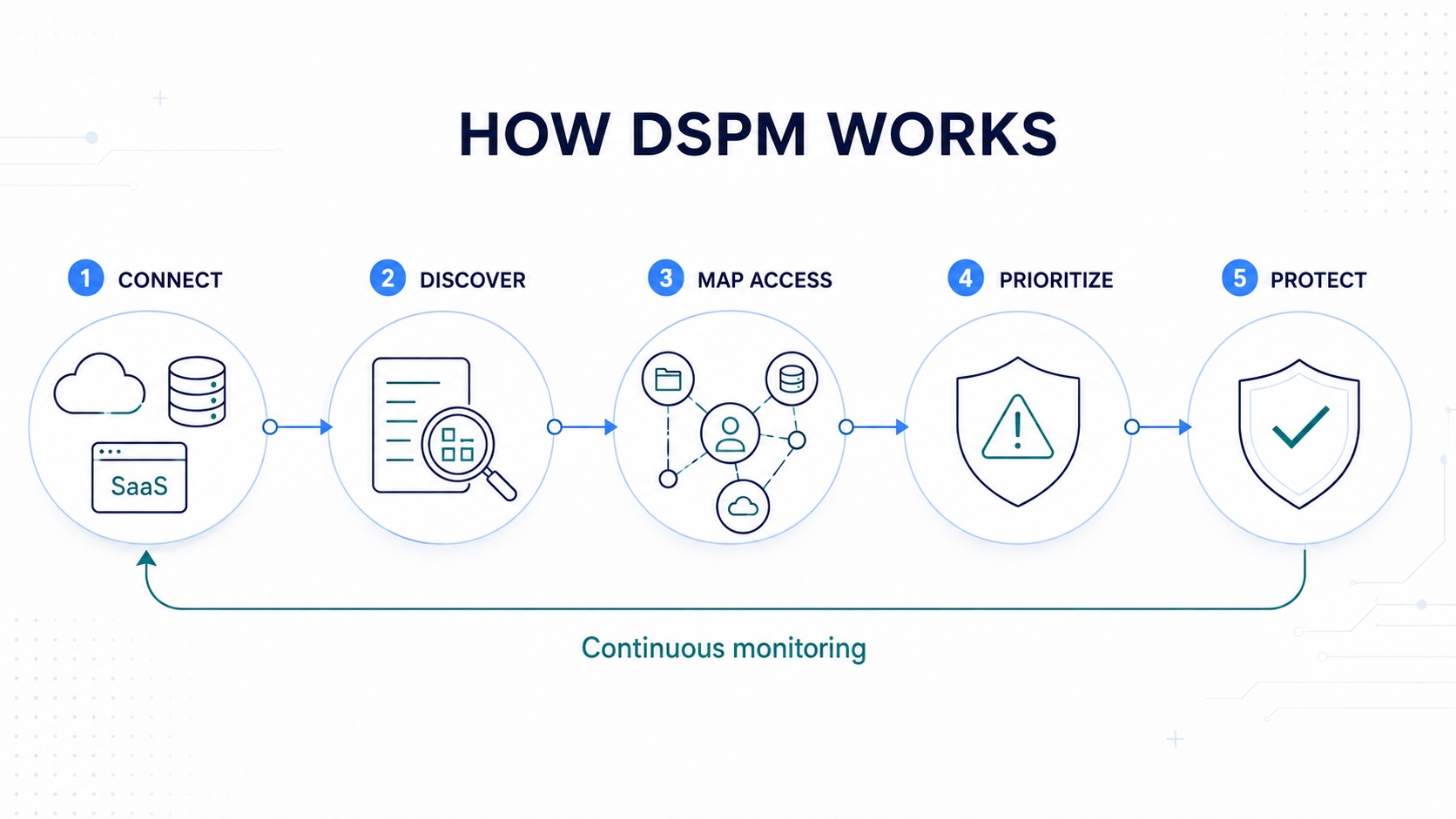
First, the platform connects to supported cloud services, databases, data warehouses, object storage, SaaS applications, and on-premises repositories. Many DSPM tools use provider APIs or agentless scanning methods, although deployment models vary between products.
The platform then scans these sources to locate structured and unstructured data. Classification engines identify categories such as personally identifiable information, protected health information, payment card data, authentication secrets, source code, and proprietary business documents.
After classification, the DSPM solution builds context around each data asset. It can examine ownership, geographic location, encryption status, public exposure, access paths, and relationships with users, roles, applications, and third parties.
Risk analysis combines these signals to identify dangerous conditions. Examples include:
- Sensitive data stored in a publicly accessible resource
- Production records copied into an unsecured development environment
- Unencrypted regulated data
- Dormant accounts with access to confidential information
- Excessive permissions assigned to users or service identities
- Sensitive data stored in an unapproved region
- Information retained beyond an established retention period
How does DSPM enhance cloud security? It helps teams prioritize such findings according to their potential impact. Rather than producing an isolated alert for every misconfiguration, cloud DSPM shows which issues create credible paths to valuable data.
Monitoring continues after the initial assessment. The platform can detect new data stores, classification changes, permission drift, unusual access, or risky data movement. Depending on its capabilities and integrations, it may recommend corrective actions, open tickets, trigger workflows, or automatically apply approved controls.
DSPM cybersecurity capabilities do not replace encryption, identity and access management, data loss prevention, or incident response. Instead, they provide the data intelligence these controls need to operate more effectively.
DSPM Use Cases and Solutions
Common DSPM use cases begin with data visibility. Organizations can create an inventory of sensitive information across multiple environments without depending entirely on manually maintained records. This is particularly useful during cloud migrations, mergers, compliance projects, and rapid infrastructure growth.
DSPM solutions can also help detect shadow data, abandoned storage, duplicate datasets, and information used outside approved processes. Security teams can then remove unnecessary copies, restrict access, apply encryption, or bring repositories under formal governance.
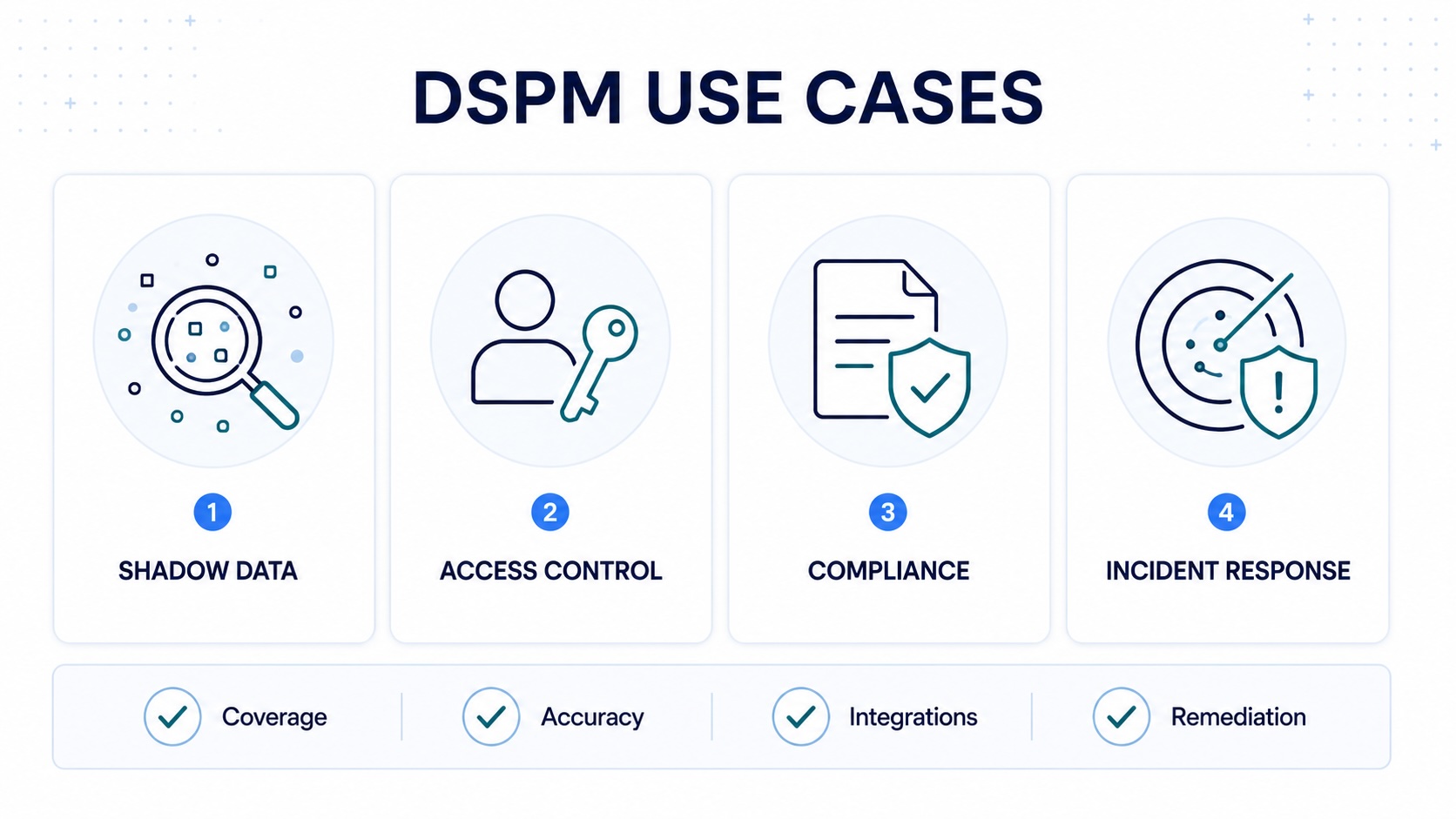
Access governance is another important use case. A DSPM tool can identify users, groups, service accounts, and external collaborators with unnecessary access to sensitive data. Teams can use these findings to enforce least privilege and review high-risk permissions.
For compliance, DSPM tools help locate regulated information and evaluate whether its storage, access, encryption, retention, and geographic location align with applicable requirements. Their reports can support audits, but adopting DSPM does not automatically make an organization compliant.
Other valuable applications include breach impact analysis, insider-risk investigations, third-party access reviews, ransomware resilience, and the protection of data used by analytics or generative AI systems.
When evaluating a DSPM solution, organizations should consider:
- Coverage of their cloud, SaaS, database, and on-premises environments
- Accuracy and customization of data classification
- Support for structured and unstructured information
- Identity, permission, and data-flow analysis
- Risk scoring based on business context
- Compliance policy coverage
- Integration with SIEM, SOAR, ticketing, IAM, and DLP systems
- Deployment requirements and performance impact
- Remediation controls and approval workflows
- Reporting for technical and business stakeholders
The best DSPM platform is not necessarily the product with the longest feature list. It is the one that provides reliable visibility across the organization’s actual data estate and fits its existing security operations.
DSPM vs. CSPM
The difference between CSPM vs. DSPM primarily concerns what each technology protects. Cloud security posture management focuses on the configuration and security posture of cloud infrastructure. It identifies issues involving networks, workloads, identities, storage services, and cloud resources.
DSPM focuses on the data stored and processed within that infrastructure. It determines which information is sensitive, where it resides, who can reach it, and how surrounding conditions affect its exposure.
| Area | DSPM | CSPM |
| Primary focus | Sensitive data | Cloud infrastructure |
| Main question | Is important data exposed? | Is the cloud resource configured securely? |
| Typical findings | Shadow data, excessive access, unencrypted records | Public resources, insecure settings, compliance violations |
| Coverage | Cloud, SaaS, databases, and hybrid environments | Primarily cloud services and infrastructure |
| Core context | Data sensitivity, ownership, and access | Configuration, vulnerabilities, and cloud controls |
The DSPM vs. CSPM relationship is complementary rather than competitive. CSPM may detect that a storage resource is publicly accessible, while DSPM determines whether it contains sensitive customer information and therefore demands urgent remediation.
Used together, the technologies connect infrastructure posture with data context. CSPM helps secure the environment, while DSPM helps ensure that the organization’s most valuable information receives protection based on its sensitivity, accessibility, and business importance.
Articles by this author