What Is CIEM? Cloud Infrastructure Entitlement Management Explained

CIEM gives security teams a clearer view of who and what can access cloud resources. Discover how Cloud Infrastructure Entitlement Management controls excessive permissions, supports least privilege, and strengthens multicloud identity security.
On this page
Cloud environments can accumulate thousands of identities, roles, policies, service accounts, and permissions. As organizations expand across multiple cloud providers, understanding who can access a particular resource — and what that identity can actually do — becomes increasingly difficult.
Cloud Infrastructure Entitlement Management (CIEM) addresses this problem by continuously discovering and analyzing cloud identities and their permissions. A CIEM platform helps security teams identify excessive or unused access, understand effective permissions, and move cloud environments toward the principle of least privilege. Microsoft, for example, describes CIEM capabilities as a way to discover, assess, and manage identity and access risks across multicloud environments while reducing excessive and misconfigured permissions.
Rather than simply recording which permissions have been assigned, CIEM focuses on what those permissions mean in practice. This makes it particularly useful in complex environments where users, applications, workloads, and machine identities may receive access through several overlapping policies or roles.
What Is Cloud Infrastructure Entitlement Management (CIEM)?
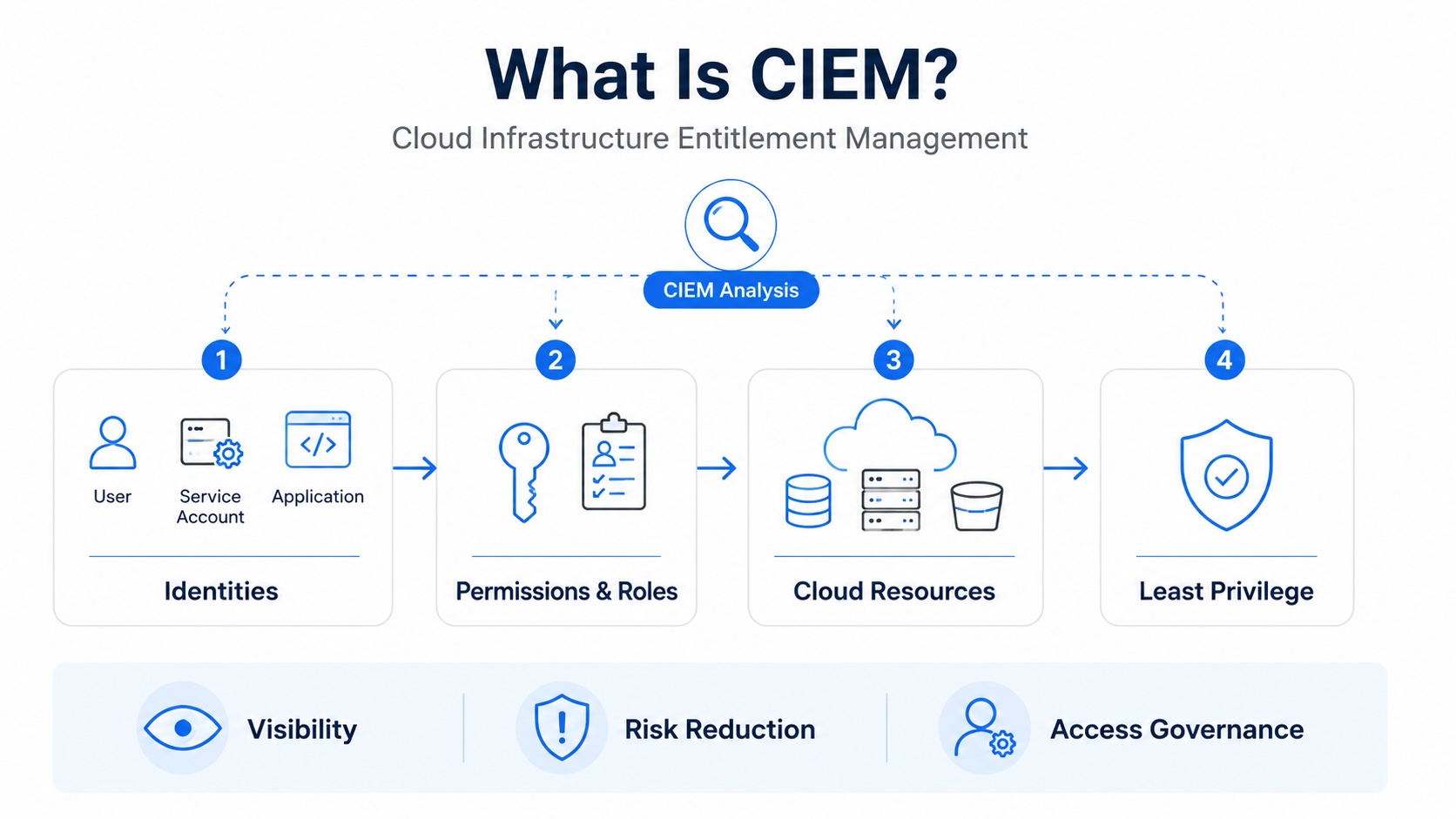
The simplest CIEM definition is a security approach for discovering, analyzing, governing, and reducing cloud access privileges. The CIEM meaning becomes clearer when looking at the problem it solves: cloud providers offer highly granular permission systems, but organizations often struggle to determine which permissions are genuinely necessary.
An entitlement is essentially an access right that allows an identity to perform an action on a cloud resource. An employee might be entitled to read data from a storage service, for example, while an application could have permission to create infrastructure, access a database, or assume another role.
The challenge is that effective access is not always obvious from an identity’s directly assigned permissions. Access can also come from group membership, inherited policies, role assumptions, cross-account relationships, or other cloud-specific mechanisms. CIEM analyzes these relationships to determine what an identity can actually reach and what actions it can perform.
This is also where Cloud Infrastructure Entitlement Management differs from conventional identity and access management. IAM establishes authentication and authorization policies and grants access. CIEM adds another layer of analysis by continuously examining the resulting permissions and identifying when access has become excessive, unnecessary, or risky.
The objective is the principle of least privilege: every human or workload identity should have only the minimum access needed to perform its legitimate tasks. AWS and Google Cloud also provide native mechanisms for identifying unused or excessive permissions and generating recommendations designed to support least-privilege access.
Why Is CIEM Important?
Modern CIEM security addresses an issue that becomes harder to manage as cloud adoption grows: permission sprawl.
Cloud environments change quickly. Developers create roles for projects, applications receive additional permissions, employees move between teams, and service accounts remain active after workloads change. Permissions that were reasonable when they were granted can therefore become unnecessary months later.
Multicloud adoption adds another layer of complexity because AWS, Microsoft Azure, and Google Cloud use different IAM models and policy structures. Palo Alto Networks notes that native cloud providers offer their own granular access controls, while CIEM provides a way to understand entitlement risk across multiple cloud environments.
Cloud identity entitlement management is also increasingly important because cloud identities are no longer limited to employees. Applications, APIs, containers, serverless workloads, automation tools, service principals, and service accounts can all hold permissions. Microsoft Defender for Cloud, for instance, evaluates both human and application identities and analyzes usage patterns for excessive, unused, or misconfigured permissions.
This makes CIEM cybersecurity particularly relevant to several recurring risks:
- excessive privileges that provide broader access than an identity needs;
- unused permissions that remain available indefinitely;
- inherited or indirect access that administrators may overlook;
- privilege escalation paths created by combinations of roles;
- inconsistent controls across different cloud providers;
- access that continues after an employee, application, or workload changes roles.
Effective cloud entitlement management reduces these risks by giving security teams a continuously updated picture of cloud entitlements instead of relying entirely on periodic manual reviews. This approach can complement data security posture management (DSPM), which adds data sensitivity and exposure context to identity and permission analysis.
How Does CIEM Work?
A CIEM tool typically begins by connecting to cloud identity, policy, resource, and activity data. It creates an inventory of human and non-human identities, roles, groups, policies, resources, and entitlement relationships.
From there, the CIEM workflow generally follows several stages.
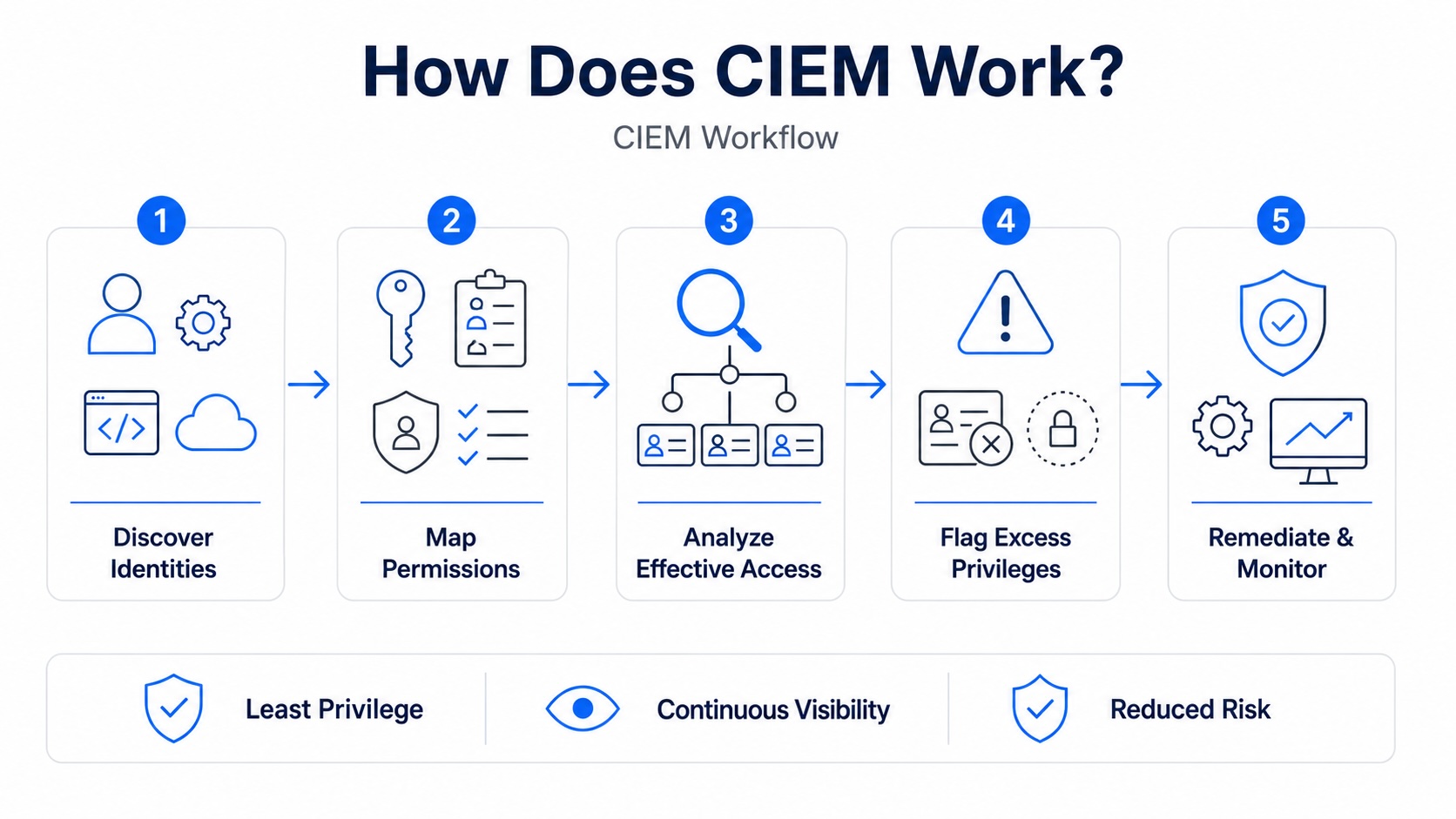
First, the platform discovers identities and permissions across the CIEM cloud environment. In a multicloud deployment, this can include AWS IAM roles, Azure identities and role assignments, and Google Cloud service accounts and IAM policies.
Next, it calculates effective access. This is an important part of CIEM identity analysis because directly assigned permissions do not always represent an identity’s true capabilities. The tool examines inherited permissions, policy relationships, group memberships, role assumptions, and other access paths.
The platform then compares granted permissions with observed activity where usage information is available. Permissions that are broad, dormant, unused, or inconsistent with an identity’s normal purpose can be flagged for review. Wiz describes right-sizing as comparing assigned permissions against observed usage to identify stale or unnecessary access and recommend narrower privileges.
Risk can also be prioritized according to context. Administrative permissions to a sensitive production database, for example, generally deserve more attention than an unused read permission on a low-impact resource.
Finally, the CIEM access process moves from detection to remediation. Depending on the platform and an organization’s policies, the system may:
- recommend removal of unused permissions;
- suggest narrower roles or policies;
- identify dangerous privilege combinations;
- revoke unnecessary access automatically;
- replace permanent privileges with temporary or just-in-time access;
- continuously monitor the environment for new entitlement risks.
CIEM is therefore not simply a permission inventory. It creates an ongoing cycle of discovery, analysis, right-sizing, remediation, and monitoring.
Key Benefits of CIEM
The primary advantage of modern CIEM solutions is visibility. Instead of switching between multiple IAM consoles and manually interpreting policies, security teams can obtain a centralized view of identities, entitlements, resources, and effective access relationships. Microsoft similarly provides multicloud permission analysis across Azure, AWS, and Google Cloud through its current CIEM capabilities.
Another major benefit is reducing excessive access. Removing unnecessary privileges means that a compromised identity has fewer resources and actions available to it. CIEM therefore helps reduce the potential blast radius of stolen credentials or compromised workloads while supporting least-privilege and Zero Trust strategies.
CIEM can also simplify security operations. Automated discovery and permission analysis reduce the amount of manual work required to review complicated cloud IAM configurations. Continuous monitoring also makes it easier to detect permission drift instead of waiting for a scheduled access review.
For compliance and governance teams, centralized entitlement information can provide clearer evidence of who has access to sensitive resources and why. Many CIEM products include access reporting, remediation recommendations, and historical information that can support internal reviews and audits.
Finally, cloud CIEM provides a scalable way to manage identity risk as cloud infrastructure grows. CIEM capabilities may be delivered through dedicated entitlement-management products or integrated into broader security platforms such as CSPM, CNAPP, privileged access, or identity security solutions. Microsoft’s current approach, for example, incorporates CIEM capabilities into Defender Cloud Security Posture Management rather than treating entitlement management solely as an isolated security function.
For organizations operating dynamic or multicloud infrastructure, CIEM ultimately provides a practical answer to a difficult question: does every identity have only the access it actually needs? By continuously analyzing effective permissions and reducing unnecessary privileges, Cloud Infrastructure Entitlement Management turns least privilege from a static policy goal into an ongoing cloud security process.
Articles by this author