Symmetric vs Asymmetric Encryption

Symmetric and asymmetric encryption protect data in different ways. Learn how each method works, their key differences, common algorithms, practical use cases, and why modern security systems often combine both.
On this page
Encryption protects sensitive information by converting readable data into ciphertext that unauthorized parties cannot easily interpret. Two fundamental approaches dominate modern cryptography: symmetric and asymmetric encryption. Although both protect information, they differ significantly in how they use cryptographic keys, how quickly they process data, and which security problems they solve best.
Understanding symmetric vs asymmetric encryption is important when designing secure applications, protecting stored information, or transferring data across networks. Symmetric encryption is generally preferred for efficient bulk-data protection, while asymmetric cryptography makes secure key establishment, authentication, and digital signatures possible. Modern security systems frequently combine the two rather than relying on only one method.
What Is Symmetric Encryption and How Does It Work?
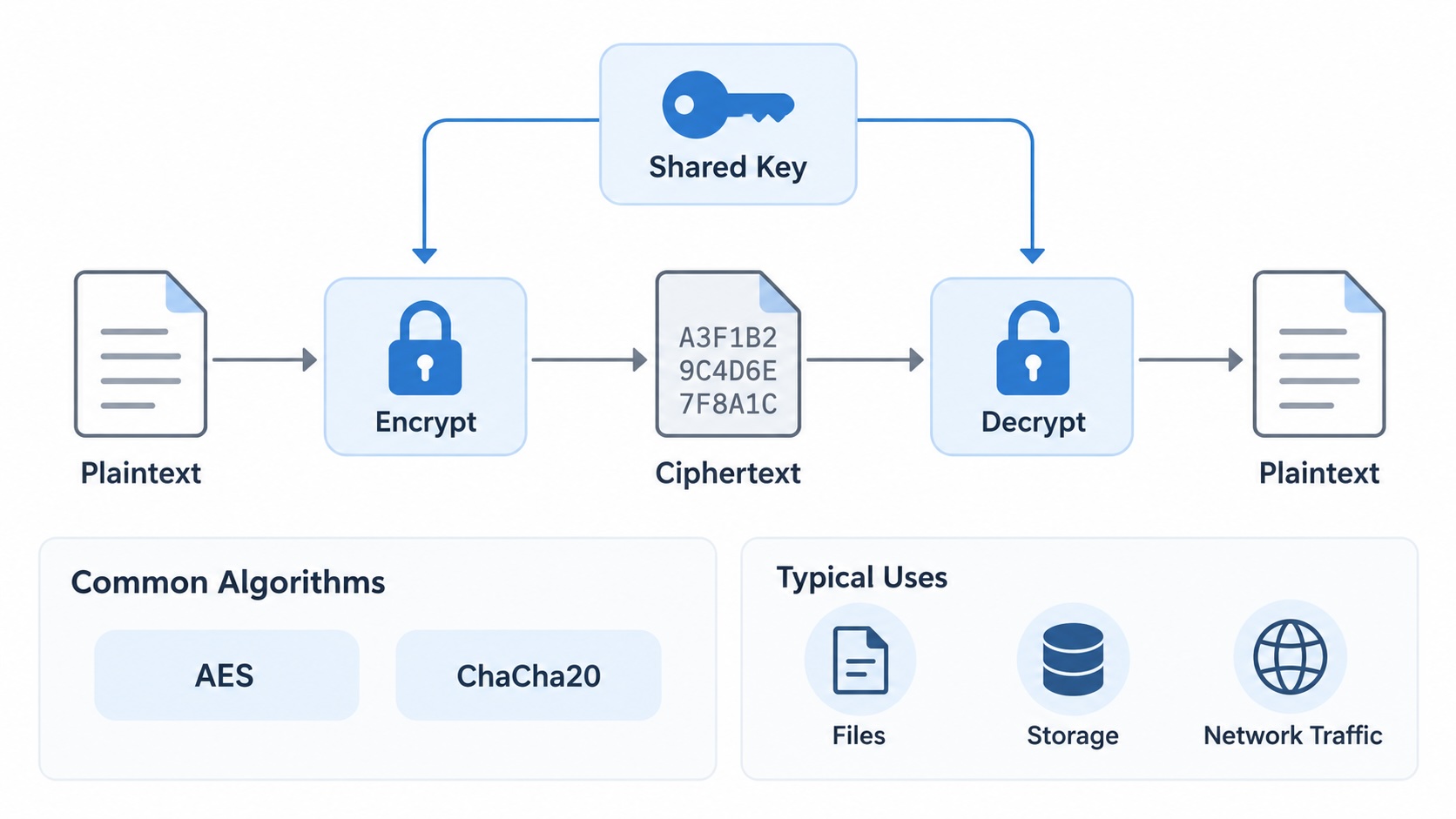
Symmetric encryption is a cryptographic method in which the same secret key is used to encrypt and decrypt information. Because both sides rely on the same secret, it is also known as shared-key encryption or secret-key cryptography.
When plaintext enters a symmetric encryption algorithm, the algorithm combines it with the secret key and transforms it into ciphertext. A recipient who possesses the same key can reverse the process and recover the original information. Without the correct key, properly encrypted data should be computationally impractical to decrypt.
The Advanced Encryption Standard (AES) is one of the most widely used symmetric encryption algorithms. AES operates on 128-bit blocks and supports 128-, 192-, and 256-bit keys. Another modern option is ChaCha20, a stream cipher commonly used in secure communications and especially useful in environments where efficient software implementation matters.
Older algorithms such as DES and 3DES played an important historical role but should not be selected for new systems when stronger modern alternatives are available.
The main advantage of symmetric cryptography is performance. It can efficiently encrypt large amounts of information, making it suitable for files, databases, backups, storage volumes, and high-volume network traffic. Full-device protection is one practical example: our guide to full disk encryption explains how symmetric encryption can protect information stored across an entire drive.
The main challenge is the shared secret itself. Both parties need access to the same key, which means that key generation, storage, distribution, rotation, and revocation must be carefully controlled.
What Is Asymmetric Encryption and How Does It Work?
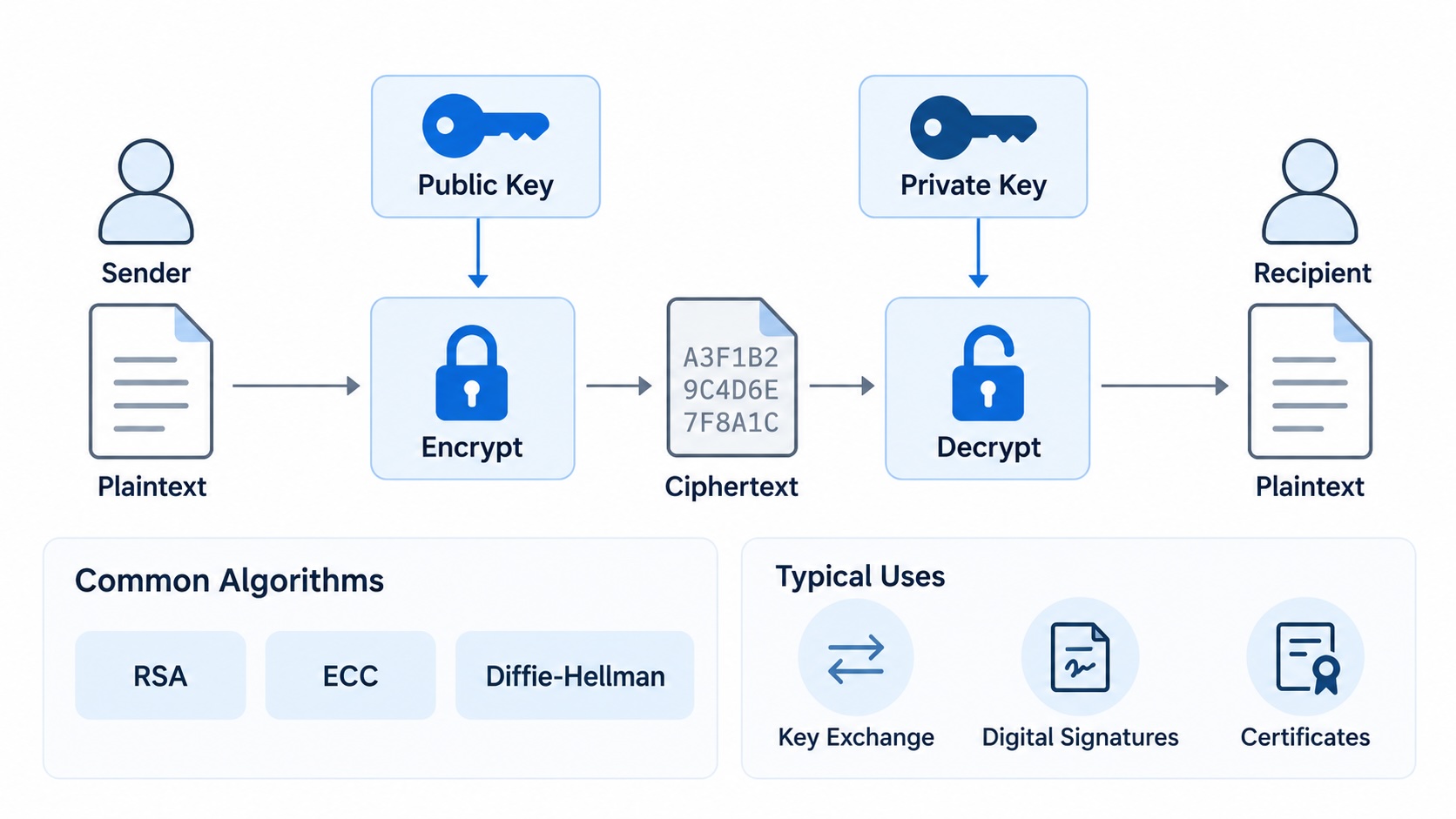
Asymmetric encryption, also called public-key cryptography, uses two mathematically related keys instead of one shared secret. One is a public key that can be distributed, while the other is a private key that must remain protected.
In a typical public-key encryption scenario, a sender encrypts information using the recipient’s public key. Only the corresponding private key can decrypt that information. This allows two parties to establish secure communication without first exchanging the same secret key through another channel.
RSA is one of the best-known asymmetric algorithms. Public-key cryptography also includes techniques based on elliptic curves, which can provide strong security with relatively compact keys depending on the scheme being used.
However, not every asymmetric algorithm is used directly for encryption. Diffie-Hellman and elliptic-curve Diffie-Hellman are key-agreement mechanisms that allow two parties to derive a shared secret. Algorithms such as ECDSA and EdDSA are designed for digital signatures rather than data encryption.
This distinction matters because asymmetric cryptography serves several purposes beyond confidentiality. It supports authentication, digital signatures, certificates, and secure key establishment.
Its disadvantage is computational cost. Public-key operations are generally much more expensive than symmetric encryption, making asymmetric techniques inefficient for encrypting large files or continuous streams of application data.
The long-term cryptographic landscape is also changing as organizations prepare for quantum-resistant algorithms. For a practical example, CloudLink recently covered the Google Cloud post-quantum roadmap, including its transition toward quantum-safe key exchange and digital-signature technologies.
Symmetric vs Asymmetric Encryption: Key Differences
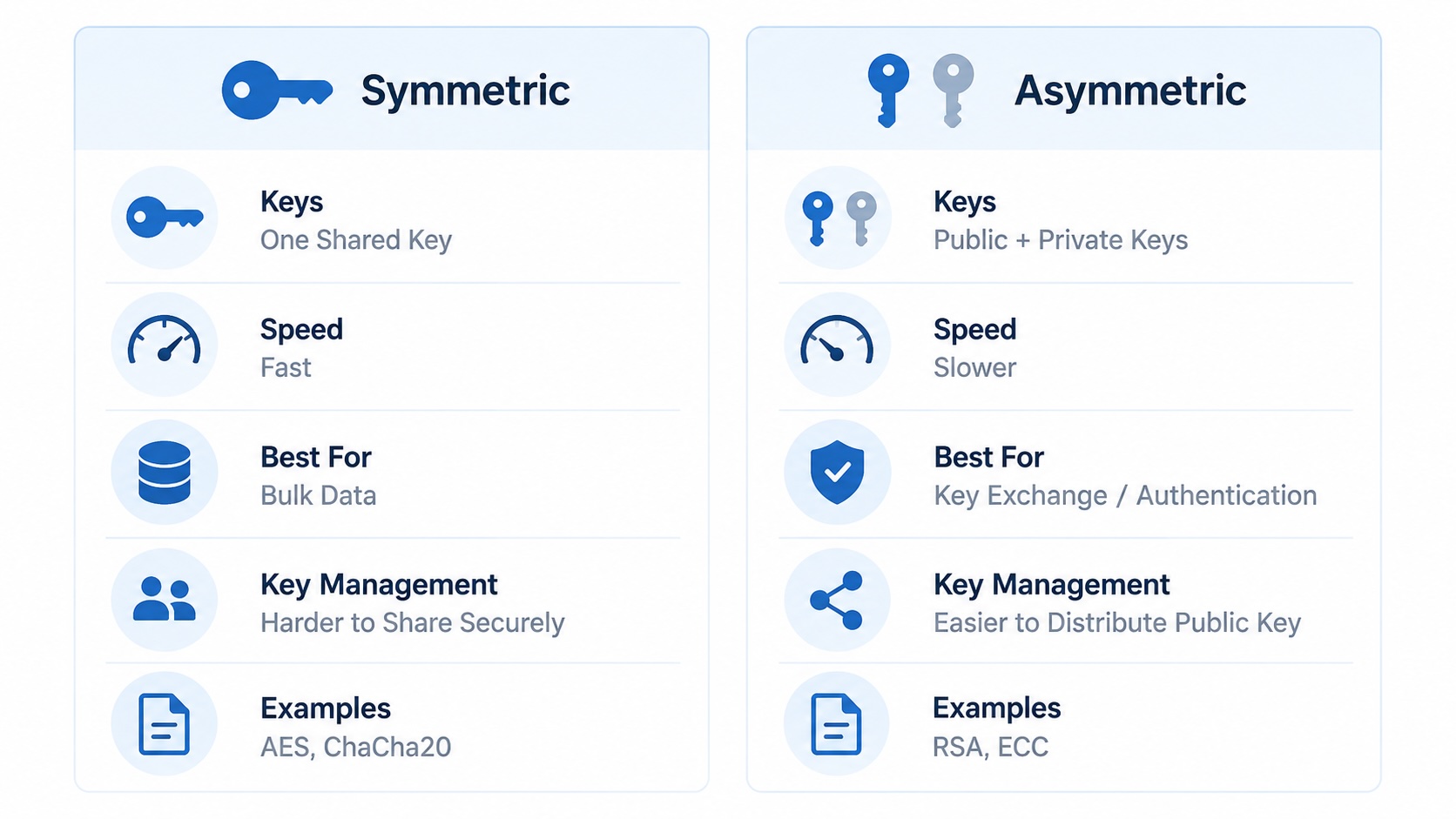
The fundamental symmetric vs asymmetric encryption difference is key usage. Symmetric systems depend on a shared secret, while asymmetric systems use separate public and private keys.
| Feature | Symmetric Encryption | Asymmetric Encryption |
| Keys | One shared secret key | Public and private key pair |
| Speed | Fast | Generally slower |
| Bulk data | Highly efficient | Usually inefficient |
| Key distribution | Shared secret must be transferred securely | Public key can be distributed openly |
| Scalability | More complex with many independent parties | Better suited to large communication networks |
| Common technologies | AES, ChaCha20 | RSA, elliptic-curve cryptography |
| Typical uses | Files, disks, databases, traffic | Key establishment, certificates, authentication, signatures |
Key management is therefore one of the most important practical differences. A symmetric key must remain confidential everywhere it is stored or transmitted. Public keys in asymmetric systems do not need confidentiality, but private keys still require strict protection.
Organizations also need processes for creating, storing, rotating, revoking, backing up, and eventually destroying cryptographic keys. Our guide to encryption key management covers these lifecycle requirements and explains how symmetric, asymmetric, session, master, and data-encryption keys fit into broader security architecture.
Neither approach is automatically more secure in every situation. Actual security depends on the algorithms, key sizes, implementation, key management, protocol design, operating environment, and intended use.
When to Use Symmetric vs Asymmetric Encryption
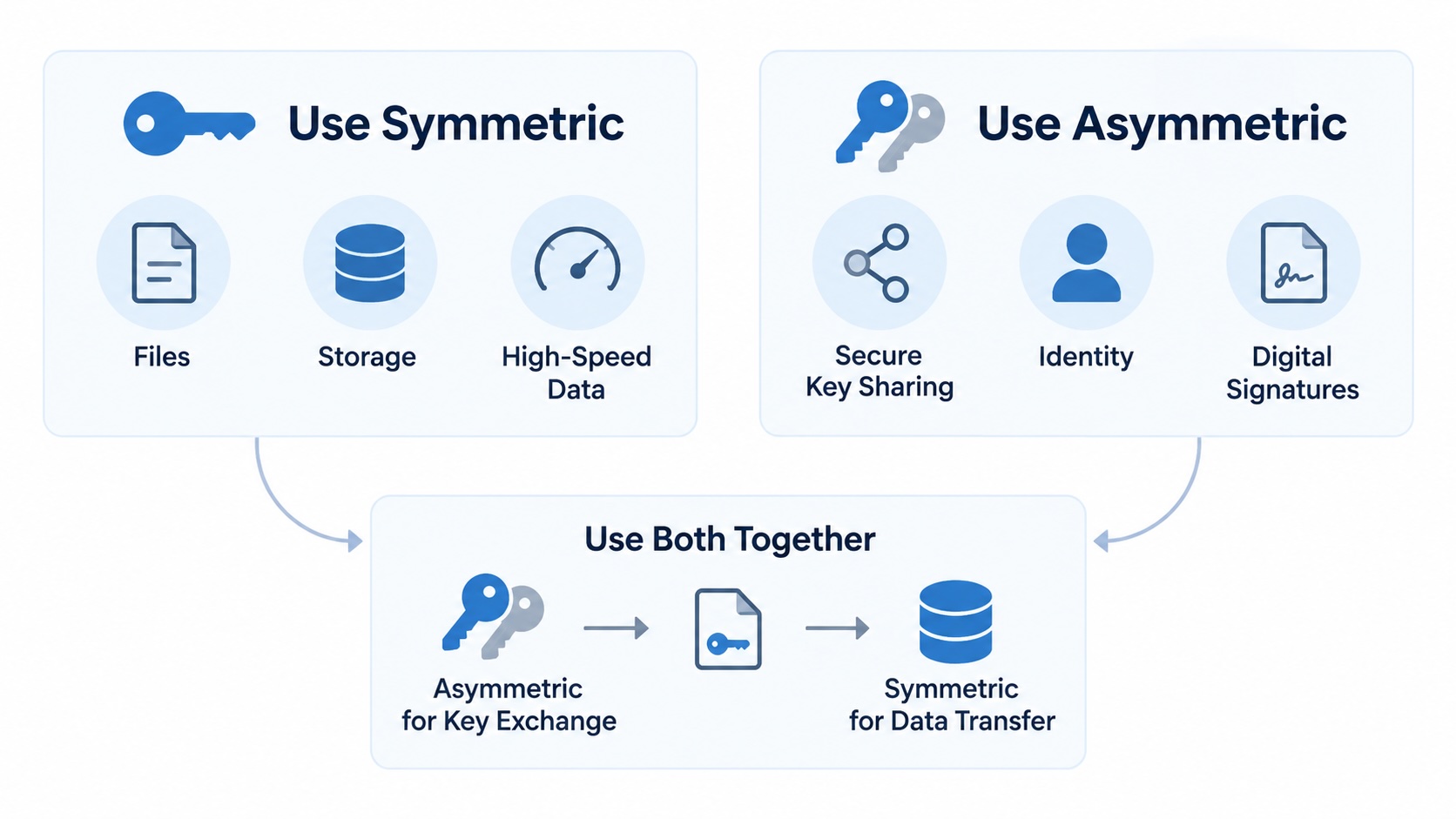
Choosing between the main types of encryption depends on what the system needs to accomplish. Symmetric encryption is usually the better option when large quantities of data must be protected efficiently.
Common symmetric encryption use cases include:
- files and large data sets;
- databases and backups;
- full-disk and storage encryption;
- high-volume network traffic;
- applications where encryption performance matters.
Asymmetric cryptography is more appropriate when parties need to establish trust or communicate securely without already sharing the same secret. Typical applications include key establishment, digital certificates, authentication, secure email technologies, and digital signatures.
Modern systems commonly use symmetric and asymmetric encryption together. Instead of applying expensive public-key operations to every byte of information, a protocol can use asymmetric cryptography to authenticate participants and establish shared session secrets. Symmetric algorithms then protect the actual application data.
TLS, the protocol that secures HTTPS connections, demonstrates this hybrid model. A modern TLS connection can use public-key certificates to authenticate a server and an asymmetric key-agreement mechanism to establish shared secret material. Session traffic is then protected with efficient symmetric authenticated encryption.
This hybrid approach provides the main advantages of both encryption methods: scalable authentication and key establishment from asymmetric cryptography, combined with the speed of symmetric encryption.
The practical question is therefore rarely whether symmetric or asymmetric encryption is universally better. Each addresses different security requirements. Symmetric cryptography excels at efficient data protection, while asymmetric cryptography helps establish trust, exchange keys, and verify identities. Secure systems choose the appropriate method for each task and manage the underlying cryptographic keys throughout their lifecycle.
Articles by this author